
The Cookie for the Real World

In 1994, a Netscape engineer named Lou Montulli solved a simple problem: the web had no memory. Every page forgot you the moment you left. So he invented the cookie — a tiny file that lets websites remember who you are.
Cookies made the modern internet possible. They’re why you stay logged in, why your cart remembers what’s inside, and the foundation for the $600B industry digital advertising industry. Google, Meta, the entire retargeting economy, is all built on a small text file. It might be one of the most consequential inventions most people have never heard of.
The real world never got its cookie.
Walk into your favorite restaurant for the fifteenth time and there’s still a good chance the host asks if you’ve been there before. The places where we spend real money and build real relationships don't remember us.
At the best restaurants, this problem gets solved the old-fashioned way: one person's memory. The maître d' who knows the woman at table 12 starts every meal with a negroni. Who knows that the VIP on 7 has a daughter who just got engaged and that the regular on 34 suddenly stopped ordering wine because his wife is pregnant.
It all lives in one person’s head. And when they leave, the context disappears.
At Magic, we’re building the infrastructure to scale that kind of contextual knowledge.
The Problem Isn’t Data, It’s Context
Restaurants already have more guest data than they know what to do with. The problem isn’t collection, it’s that none of these systems understand what the data means or how to act on it.
Today’s CRMs store facts, but they don’t understand how those facts relate to each other. And that’s where the value lives. Most AI approaches use vector search to find what’s “similar” to your query, but a guest being pregnant and a guest not drinking aren’t semantically similar concepts. An embedding model won’t place them near each other, even though one explains the other.
Context Graphs as a New Primitive
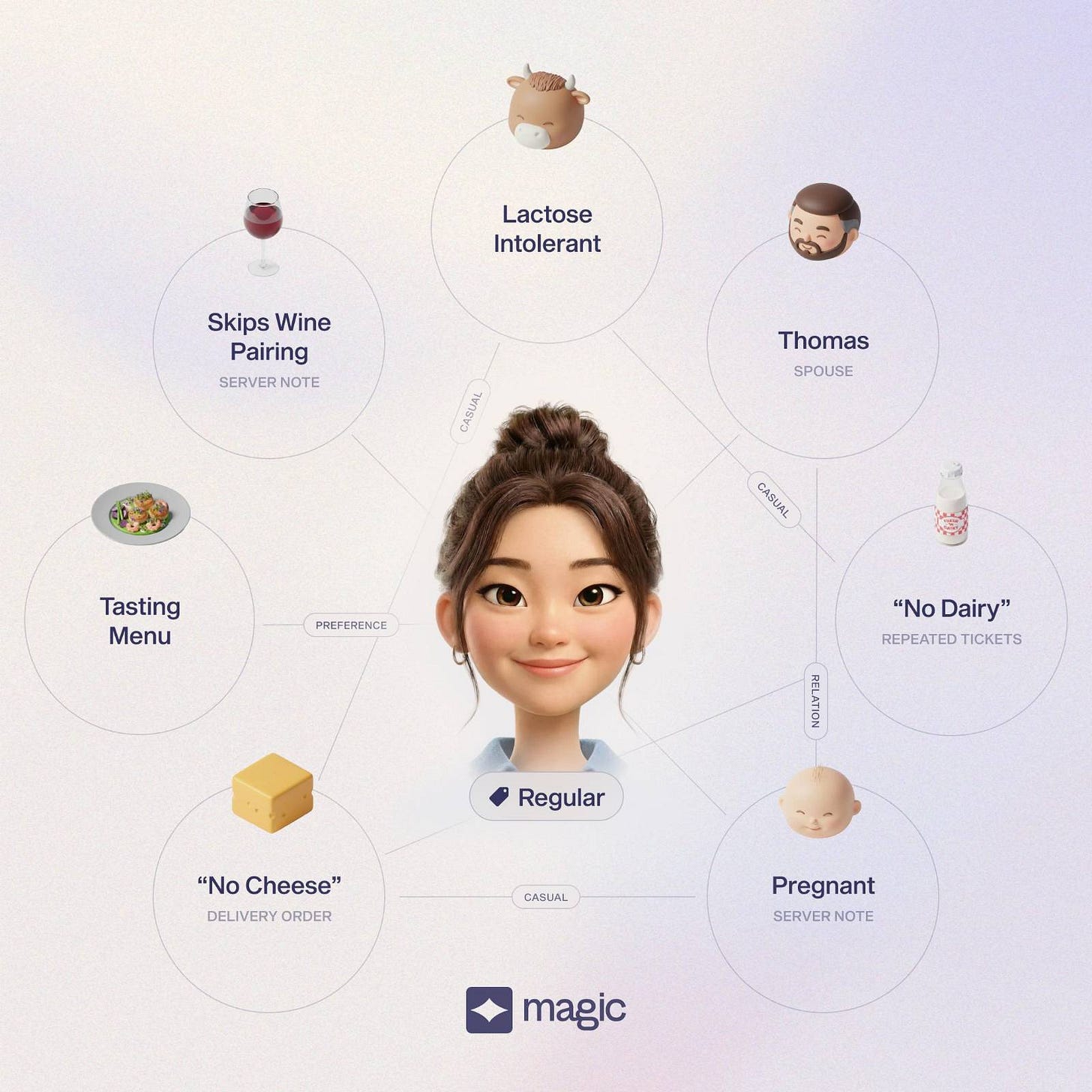
Guest data is scattered across a dozen fragmented systems. Each contains partial information, recorded in different formats, with varying levels of reliability. Perfect data hygiene doesn’t exist. Instead of fighting that reality, we use LLMs to unify it. In a graph, each node represents a fact and each edge represents a relationship.
A guest’s graph might include:
a spouse node
a pregnancy connected to dietary preferences
an anniversary date
a pattern of ordering the tasting menu but skipping wine
Instead of retrieving the “top five similar vectors,” an AI system can traverse context directly and understand why things matter and what action makes sense in the moment. This is the difference between storing information and understanding a guest.
Why Now?
The biggest challenge is constructing the graph from messy, scattered data points. LLMs finally make it possible to turn unstructured service notes into structured memory. The model understands that “no dairy” in a delivery order, “wife can’t do lactose” in a server note, and “no cheese” on repeated tickets all express the same underlying fact.
Models can now interpret unstructured data, infer entities, and map relationships automatically. For the first time, the physical world can actually build context the way the digital world did.
Delivering the Right Information at the Right Moment
Having the graph isn’t enough. You have to surface the right information at the right time — on the iPad at the host stand, in the point-of-sale interface when the server opens a check. And the job isn’t to surface everything about a guest. It’s to compress the graph into the two or three things that actually matter for this interaction.
The digital world remembered us and became a trillion-dollar economy. The physical world is just getting started. We began with restaurants because they are the highest-frequency, highest-context service environment: the perfect place to build and train this infrastructure. But the pattern is identical in hotels, retail, travel — anywhere service depends on knowing things about the person in front of you and acting on that knowledge in real time.
We’re building the cookie for the real world.
If your hospitality group is looking to supercharge your data, we’d love to chat.
Book a Demo Maggie Tang