
Introducing Guestbook Studio: What we learned cleaning hundreds of guestbooks
At first, we did everything manually.
When we onboarded our first restaurant, we did everything manually. We exported their reservation history, cross-reference it with their POS data, then tried to figure out why the same guest appeared six times with three different email addresses.
The more restaurants we onboarded, the more we realized this was a pattern. A guest books through the reservation platform under one email, places a delivery order under another, and buys a gift card on the website under a third. Tags accumulate from managers over the years. Fields that were supposed to capture guest preferences end up filled with free-text notes.
The data isn’t wrong exactly, it’s just fragmented, inconsistent, and untrustworthy. If operators don’t trust their data, they won’t use it. Marketing teams hesitate before every send because they’re not sure if they’re about to email someone twice. Operators ignore tags because they can’t rely on them. The key insight:
Personalization can’t scale until we fix the foundation.
So we went location by location, system by system. We’d standardize naming conventions, merge duplicate profiles by hand, archive outdated tags, map how checks should match, and build out a data schema that actually reflected how that specific restaurant operated.
It worked. Operators trusted the output because we’d been through it with them. But it didn’t scale — every new onboarding was its own manual project, and the ongoing maintenance was a never-ending job.
So we started building agents to do it instead
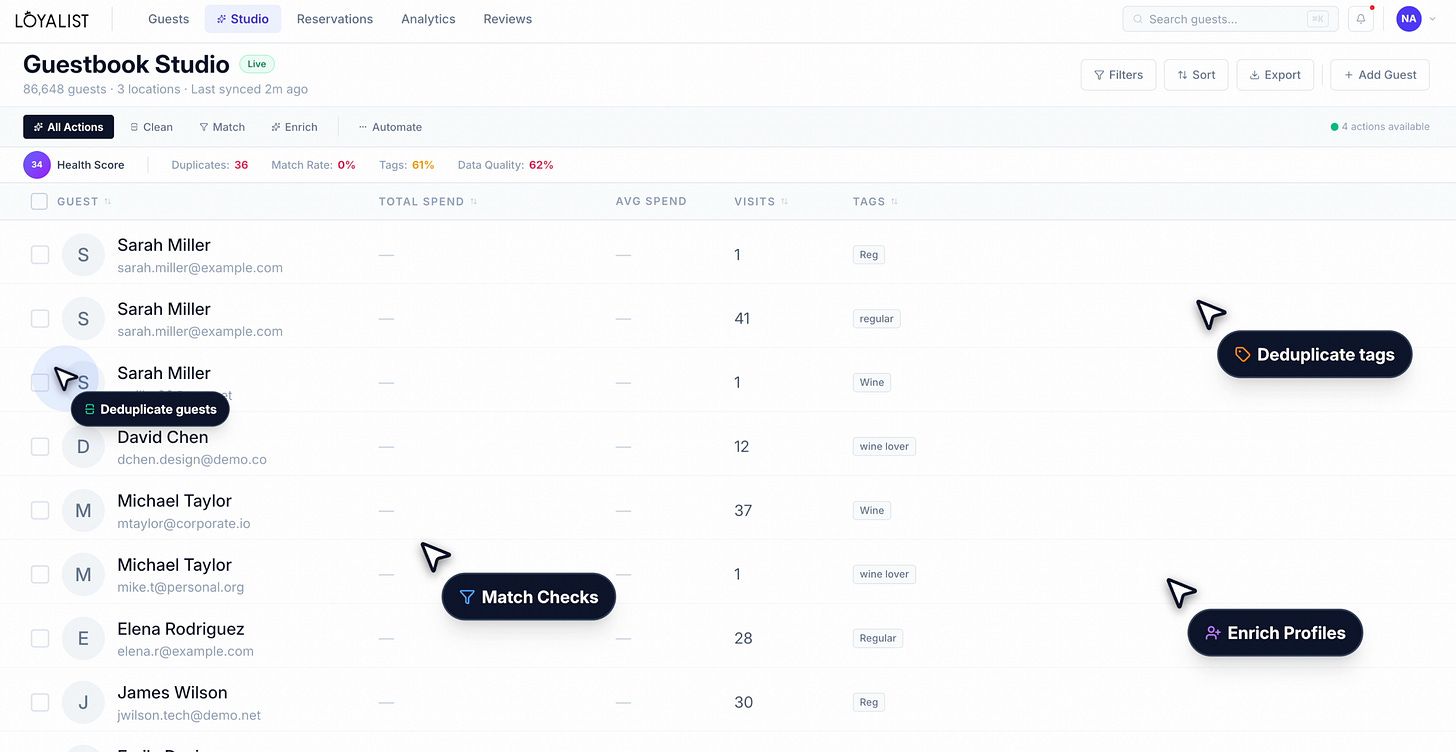
The first thing we automated was deduplication. Recognizing that “Jenna Smith,” “Jenna Smyth,” and “J. Smith” with the same phone number are the same person is exactly the kind of fuzzy pattern matching that LLMs are good at. We built an agent that could work through a guest database, flag likely duplicates with confidence scores, and resolve them either automatically or with a human in the loop for edge cases.
Next was normalization agents — ones that could look at a field full of inconsistently entered wine preferences and standardize them into a structured taxonomy, or take five years of free-text allergy notes and extract clean, queryable data.
Over time these features became a suite of tools called Guestbook Studio.
Guestbook Studio is the foundation for personalization
Guestbook Studio is an orchestration layer for all of those agents that operators can run themselves. It starts with a diagnosis — a full hygiene report that surfaces exactly what can be optimized across every data source connected to the platform.
Then, based on that diagnosis, Studio kicks off the relevant agents. Deduplication runs. Normalization runs. The schema gets structured around how that specific business actually operates — not forced into a generic template. The process that used to take our team weeks of manual work now happens in a fraction of the time, with humans reviewing and approving rather than doing the grunt work themselves.
We've seen these data challenges across hospitality verticals — hotels, wellness, retail — and while each looks different on the surface, the core insight hasn't changed since our earliest onboarding: a clean data foundation is the prerequisite for everything else.


If your hospitality group is looking to supercharge your data, we’d love to chat.
Book a DemoFrequently asked questions
How does Loyalist match duplicate guest profiles?
It compares records from every connected system, reading the name alongside phone and email, and scores how likely two records are the same person. Matching stays inside your restaurant group and never runs across groups. Likely matches appear in Guestbook Studio for someone to confirm, and automatic merging stays off unless you turn it on.
Why is restaurant guest data so messy?
The same guest books under one email, orders delivery under another, and buys a gift card under a third. Tags pile up from managers over the years, and preference fields fill with free text. Nothing is broken, it is just scattered. That is why operators stop trusting tags and marketing teams hesitate before a send.
What does a guestbook hygiene report show?
It is the first step in Guestbook Studio. It reads every source you have connected and lists what can be cleaned up: likely duplicate profiles, names entered inconsistently, tags nobody has used in years, and free text sitting where a set value belongs. You see the list before anything changes.
Can I use Guestbook Studio on my account today?
It is rolling out account by account, so it depends on your account. The parts operators use every day are already in the platform: unified profiles, matching, tags, and segments. Ask your Loyalist contact whether Studio is on for your locations.
 Loyalist Staff