
Introducing Journeys: The infrastructure behind the magic

When Walt Disney built Disneyland, he didn’t just build rides. He built something underneath them: A system of tunnels called the Utilidors so cast members could move between Frontierland and Tomorrowland without ever interrupting the experience. He hired a team he called “Imagineers” — imagination plus engineering — whose entire job was to make sure the magic on stage was supported by infrastructure backstage. He even paid attention to the smell of Main Street, pumping vanilla through the vents to evoke a feeling of home before any guest had said a word.
This is what made Disney, Disney. The experience felt magical because it was engineered to be.
Hospitality has always understood the magic but it never had the engineering.
The Challenge with Scaling Hospitality
At its core, hospitality has always been about one thing: making someone feel seen. The host who remembers your name. The server who knows you prefer still over sparkling. The maitre d who booked your favorite corner table before you asked. These moments aren’t accidents but rather the product of deep attention and care.
But this kind of attention doesn’t scale. The best operators end up focusing on the top 1%, the biggest spenders, the most frequent visitors, the ones who happen to know the right person, while everyone else gets a generic experience.
It’s the opposite of what Walt built. Disney spent decades engineering the show so that every guest, not just the high rollers, walked into something that felt designed for them. Walt figured out how to scale the magical VIP experiences but for everyone.
Today, we’re launching Journeys
Journeys is the next evolution of Loyalist and the most powerful product we’ve built to date.
It lets you design an end-to-end guest experience — multi-step, multi-venue, multi-vertical — and Loyalist runs the show across every system your brand uses.
Here’s what that looks like in practice:
A guest books a spa treatment at a hotel. After her massage, Loyalist triggers a personalized lunch recommendation and pushes a note into the reservation system so the server mentions the post-spa menu. When she arrives, her usual matcha is waiting — comped automatically because it’s her sixth visit this quarter. When she returns to her room later that night, the lavender body scrub she used at the spa was left there as a gift for her birthday.
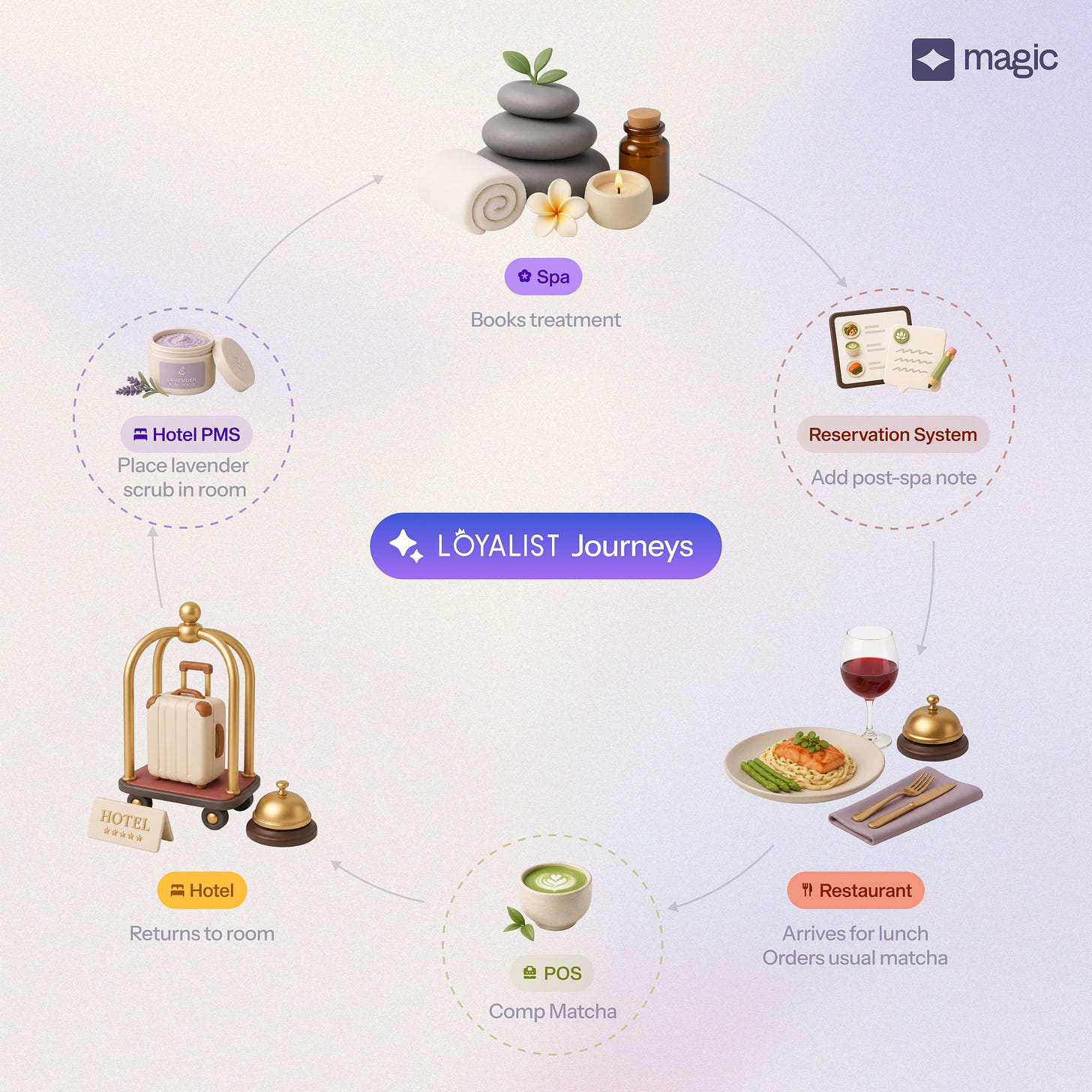
None of that required a team of people to orchestrate the entire experience end to end. Loyalist automatically pulled data from the spa system, pushed tags into the reservation platform, triggered the comp in the POS, and sent an action to the PMS — across four systems of record, seamlessly.
This is the Utilidor. The guest sees one continuous experience. Underneath, four systems are quietly doing exactly the right thing at exactly the right moment.
How it actually works
What makes Journeys different from any marketing automation tool on the market is that it isn’t just sending emails and SMS. There is a two-way actions layer that reads and writes across every operating system to operationalize the guest experience in real time. Under the hood, Loyalist’s agents are recursively iterating – adjusting parameters, adding or subtracting additional actions, and tuning thresholds against the outcome you’ve set, whether that’s lifting visit frequency, driving spend per cover, or re-engaging lapsed guests.
It’s also why Journeys get smarter the longer you run it. Walt called it “plussing” — the idea that an experience is never finished, only continuously improved. Every journey you build learns from every guest who flows through it. The system learns from what works, discards what didn’t, and adjusts itself in the background. What you launch on day one is the floor, not the ceiling.
Disney spent half a century proving that magic, at scale, isn’t an accident. The tunnels, the vanilla in the air, the castle pulling you down Main Street, they’re all engineered to feel effortless.
Journeys give every hospitality brand the building blocks to engineer experiences. If you’re a hospitality operator ready to scale experiences that feel like magic, we’d love to talk.
Maggie & the Magic Team ✨
If your hospitality group is looking to supercharge your data, we’d love to chat.
Book a DemoFrequently asked questions
What are the different types of journeys a person can build?
There is no fixed template. You build a Journey around an outcome, usually more visits, higher spend per cover, or winning back guests who have gone quiet. In practice that looks like a welcome after a first visit, a win-back when a regular stops coming, or something built on an occasion like a birthday. One Journey can run across several venues.
What can journeys integrate with?
Journeys read from the systems you already run: reservations, point of sale, online ordering, ecommerce, events, and hotel PMS. A visit, a check, a quiet stretch, or a tag can all start one. What goes back out is narrower: notes and tags reach supported reservation platforms, while POS and PMS data are used as triggers and conditions.
How is a journey different from an email campaign?
A campaign goes out to a segment, which is a set of people defined in advance, like a mailing list. A Journey is a sequence with triggers and conditions that reacts to what a guest actually does, and its actions are not limited to messages: it can apply a tag or write a note back into a supported reservation platform so the host reads it at the door.
How do you measure the results of a journey?
Loyalist attributes outcomes back to the Journey that produced them, measured in bookings and revenue inside an attribution window rather than in opens and clicks. An open rate tells you a message was seen. Attribution tells you a guest walked in.
 Maggie Tang